Metal forming and deep drawing can consume a large amount of press energy as longer drawing distances are required. For example, a mechanical press with a capacity of 50 tons uses 5 kJ energy to form 10 mm, while a deep draw of 30 mm from the same material with the same force requires 15 kJ energy.
In addition, the 1.4016 stainless steel materials have a yield strength of 750 MPa, while DX53D has a yield strength of 380 MPa. When the same mold is switched to stainless steel, the press force and therefore the press energy will double.
It is essential for the press manufacturer to provide a table detailing the press speed in automatic mode, nominal press force, and energy capacity. Although stamping companies commonly share their press tonnage capacity with toolmakers, they often overlook specifying the energy capacity. Failure to consider the press energy capacity can result in inaccurate press selection, particularly for deep drawing applications.
Energy Capacity and Flywheel Speed
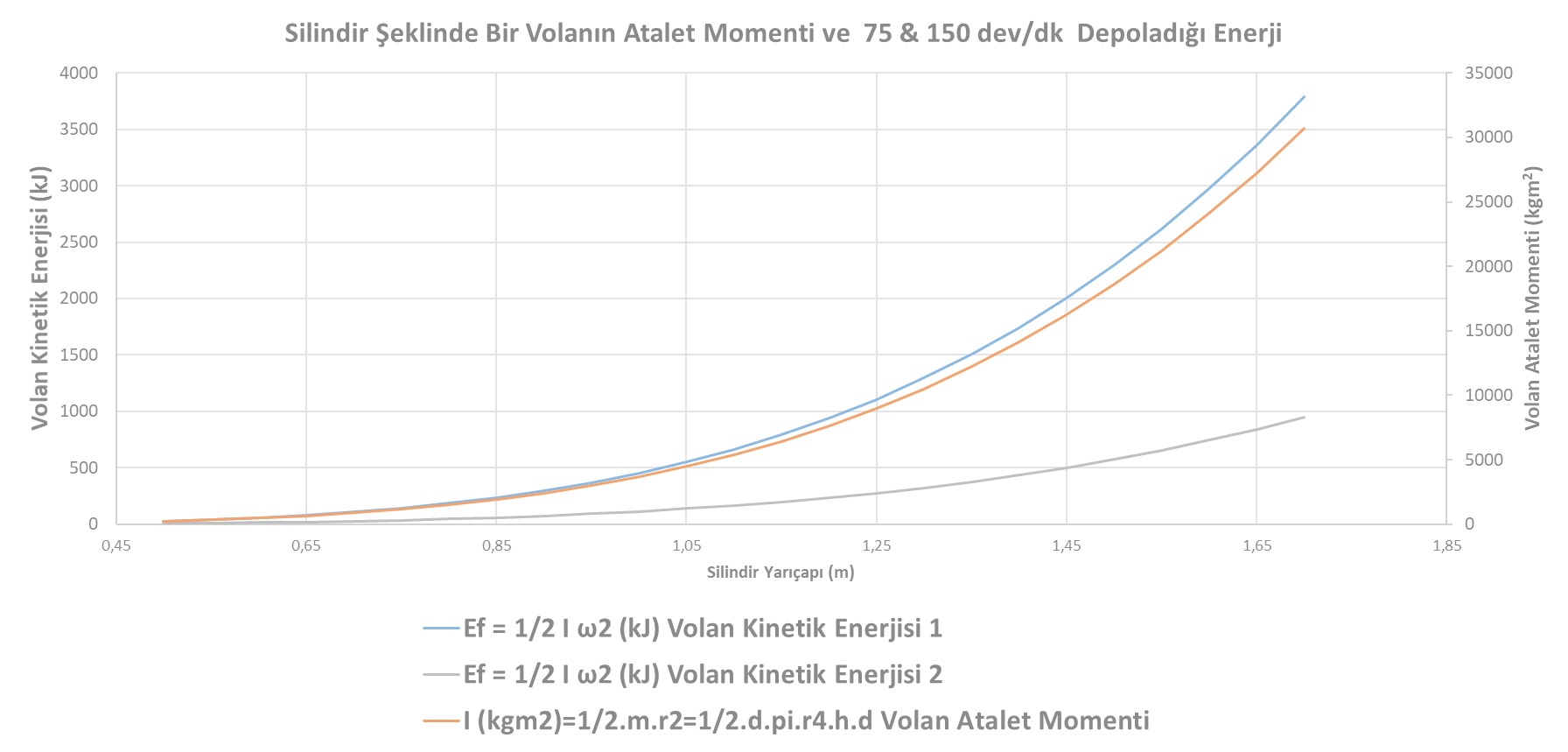
When comparing different types of presses, a mechanical press equipped with intermediate reduction gear boasts a superior energy capacity. This is attributed to the ability to rotate the flywheel at a faster pace — the energy stored in the flywheel is directly proportional to the square of its angular velocity.
Research indicates that the energy stored in the flywheel increases 4 times as the flywheel speed increases from 75 rpm to 150 rpm.
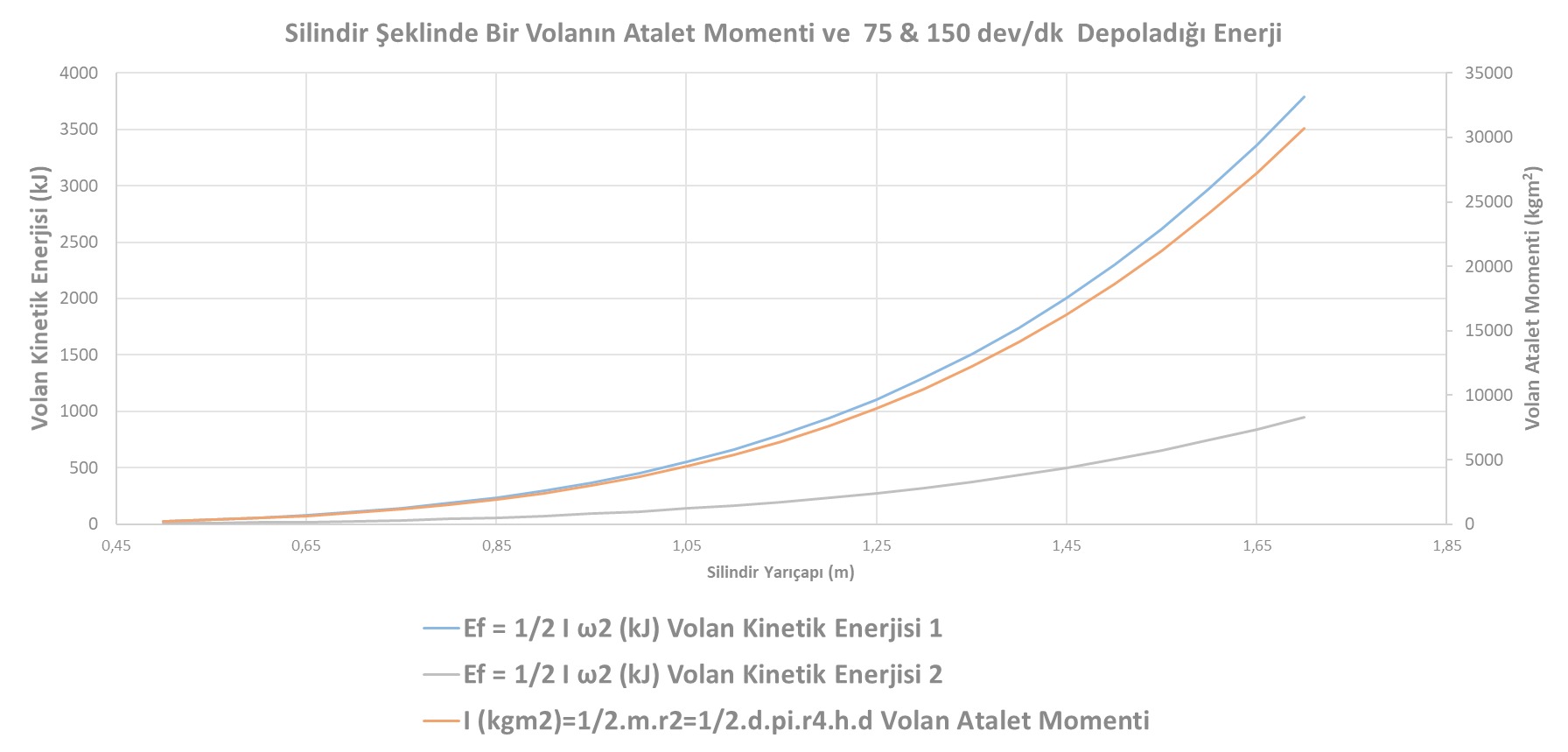 Flywheel Energy Capacity Graph
High-Strength Steel Considerations
Working with higher strength steels compared to mild steels necessitates significantly greater blank holder and punch forces, leading to elevated friction forces and interface temperatures. If the interface temperature surpasses a critical threshold, lubrication failure and other forming problems may arise.
A common practice is to decrease press speed to reduce process operating temperatures. However, if the press speed falls below a critical threshold, the available energy can diminish rapidly.
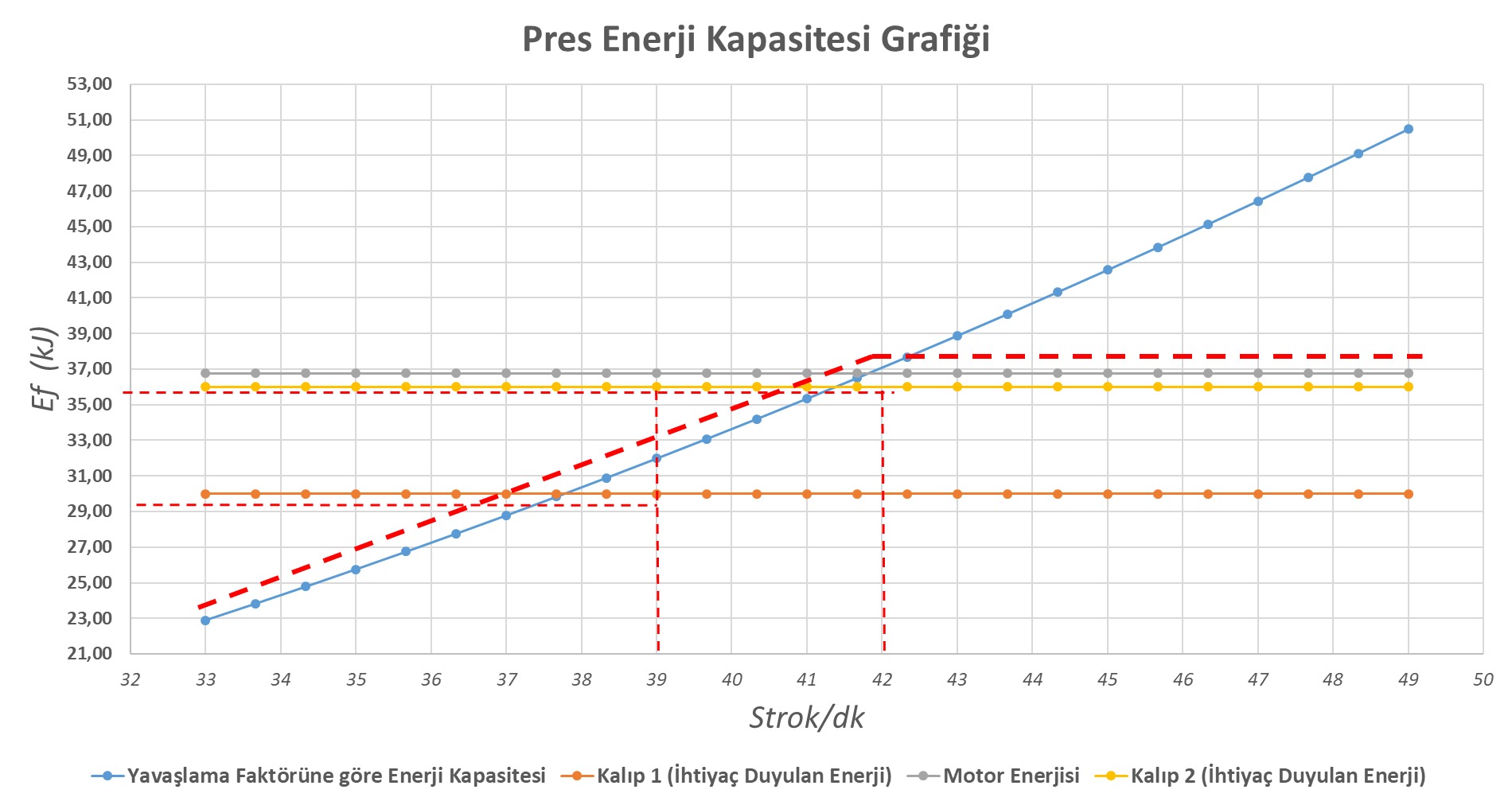 Press Energy Capacity Graph
Reading the Energy Capacity Graph
The graph shows:
- Gray line — energy that the motor can transfer to the flywheel per stroke.
- Red line — energy that the flywheel can transfer to the ram with a 20% speed decrease.
- Orange/Yellow lines — energy requirement per stroke for two different dies.
Example at 39 strokes/min:
- Die-1 (orange, 30 kJ/stroke) — operates without problems (flywheel capacity = 32 kJ).
- Die-2 (yellow, 36 kJ/stroke) — will have problems; press speed must be increased to 42 strokes/min.
If a die requires 39 kJ/stroke, the motor cannot provide enough energy regardless of press speed — the flywheel slows down after each stroke and eventually becomes inoperable.
Emrah Demirezen — Metal Forming Specialist, Press Designer
info@demirezenengineering.com