The Rated Tonnage and the Rated Tonnage Height in Mechanical Presses are the two most critical specifications. When investing in a mechanical press, common important points are tonnage, table and ram dimensions, or press speed. However, the rated tonnage height is the most important press design parameter that is often overlooked — an incompatible value can cause serious damage to your press, shorten its life, and even cause it to crack at the weakest point in its design.
Simple Structure of a Mechanical Press
Mechanical presses are energy-limited machines. They work by transferring the energy stored in a flywheel to the ram via a clutch, crank-connecting rod, eccentric gear, or bone joint mechanism.
As long as there is enough energy in the flywheel, the ram can apply the load that the die requires throughout the stroke.
Critical example: If you connect a die that requires 200 tons to your 100-ton press and the flywheel has enough energy — your press can apply 200 tons of force. The problem: if the crankshaft, bearings, connecting rod, or body is designed for 100 tons, the weakest component may break, or the clutch may slip.
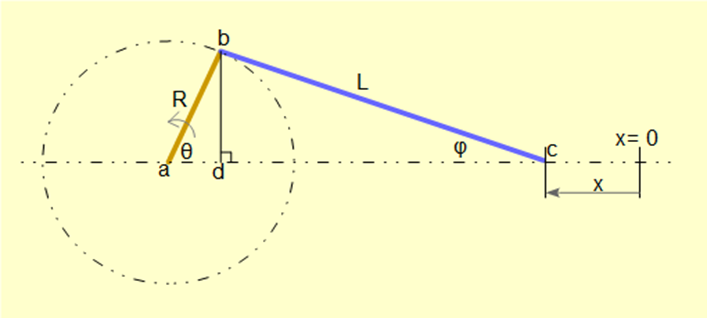 Eccentric Press Crank Slider Mechanism
Why is Rated Tonnage Height Defined?
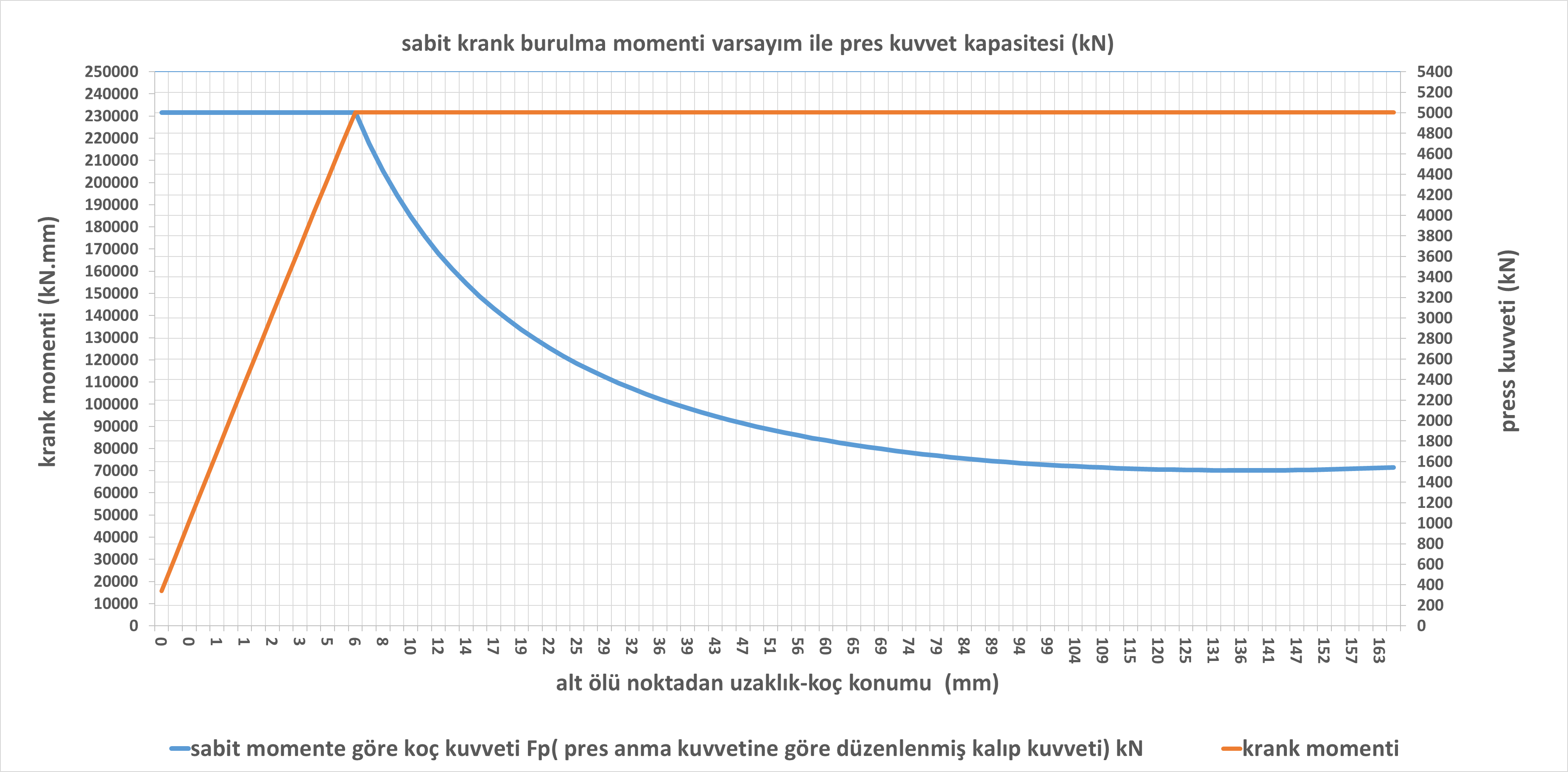
Assume a 5000 kN mechanical press tries to press a constant load throughout its stroke. The resulting torsional moment in the crankshaft increases to 780,000 kN·mm. However, the same 5000 kN pressing force can be achieved 6 mm above bottom dead center with only 210,000 kN·mm crank moment.
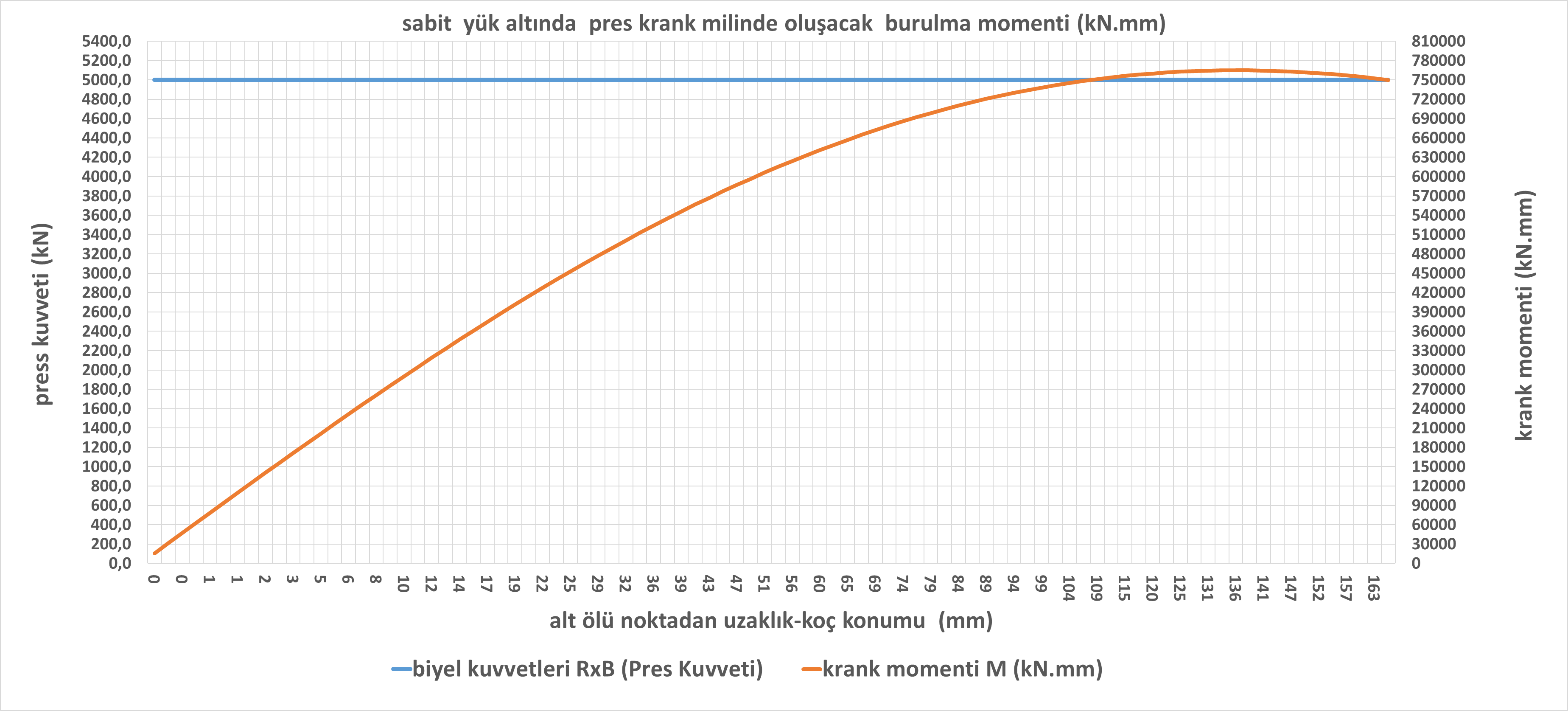 Ram Position - Press Force & Crank Moment Graph
To limit the crank torsional moment in press design, the moment at a position corresponding to 15–30 degrees of crank angle is accepted as the design criterion. In this example, approximately 6 mm from bottom dead center corresponds to 15 degrees of crank angle. This point is the rated tonnage height, and the crank torsion moment at this point (~230,000 kN·mm) becomes the design moment.
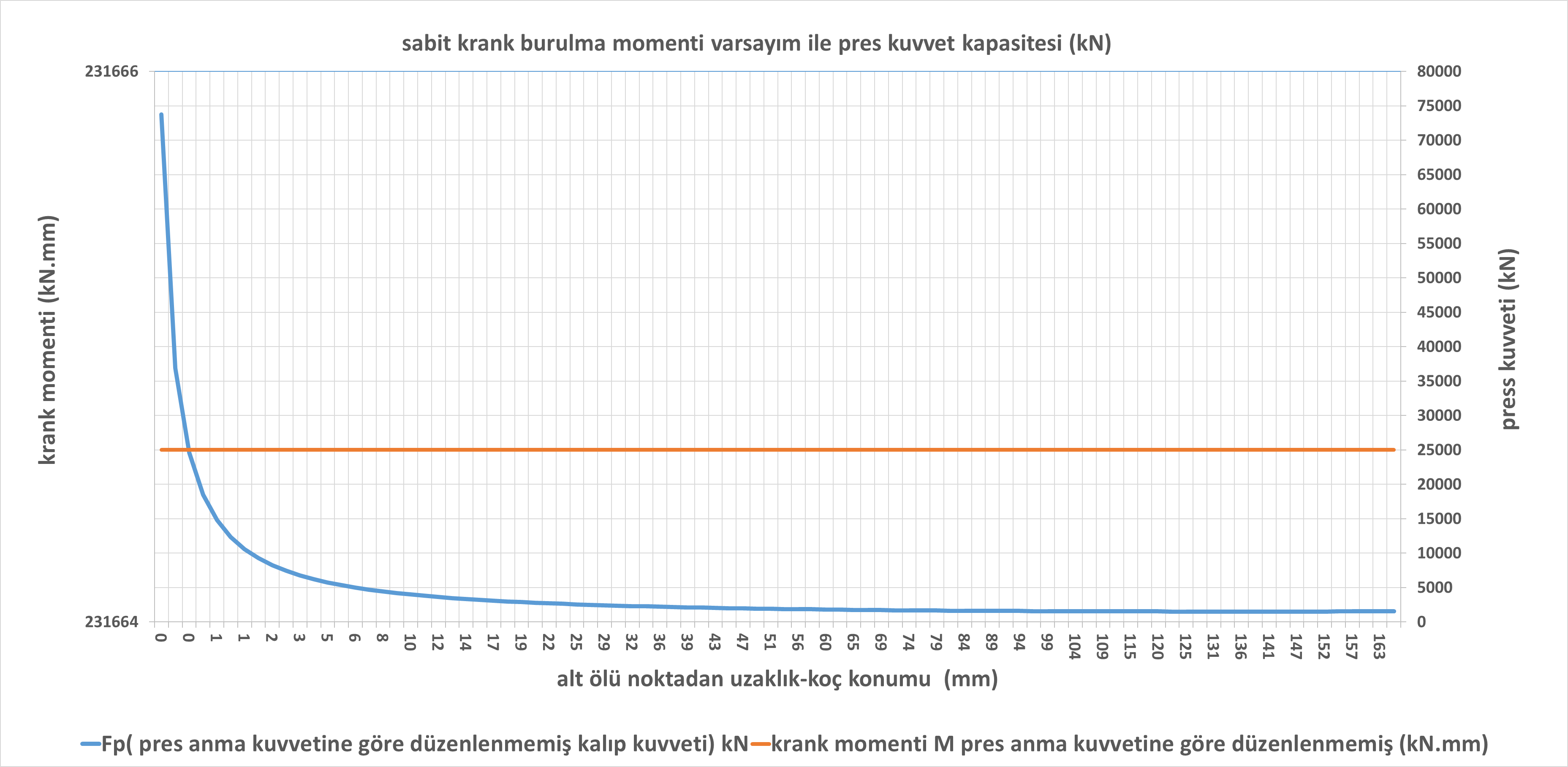 Ram Position - Press Force & Crank Moment Graph
Practical Rules
- If pressing below the rated tonnage height → the connected die must require a force ≤ rated tonnage.
- If pressing above the rated tonnage height → pressing force must stay below the values shown in the press force graph (blue line) to avoid exceeding the design moment.
The force capacity diverges toward infinity below rated tonnage height due to the crank-connecting rod geometry — which is exactly why connecting the wrong die to a mechanical press is so dangerous.
Emrah Demirezen — Metal Forming Expert, Press Designer
info@demirezenengineering.com